Medical AI · Neural Architecture Search · Transferability
Understanding Knowledge Transferability in Differentiable Architecture Search for Skin Lesion Diagnosis
IISE Transactions on Healthcare Systems Engineering, 16(1), 71-90, 2026
Research question
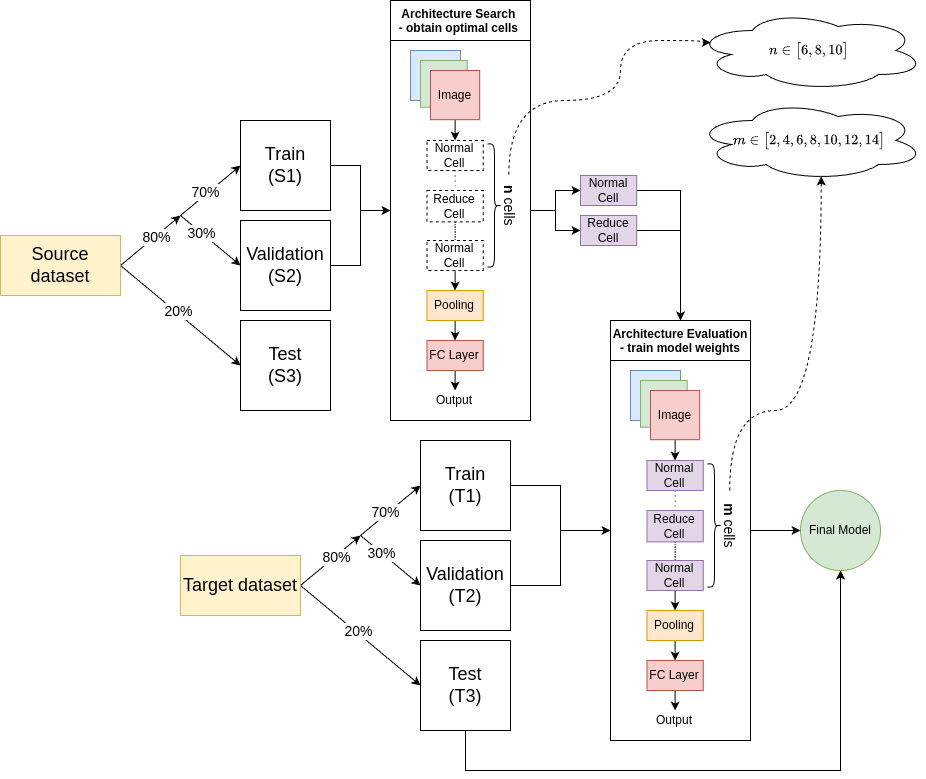
Neural architecture search can identify task-specific network structures, but repeating the search for every new medical-imaging dataset is computationally expensive. This work asks whether a cell architecture discovered on a larger dermoscopic source dataset can be reused effectively when the target images differ in acquisition modality, sample size, class balance, and resolution.
The study isolates architectural knowledge from pretrained feature transfer. Progressive Differentiable Architecture Search discovers normal and reduction cells on a source dataset. Those cells are then stacked into target evaluation networks, assigned newly initialized weights, and trained on the target data from scratch.
Study design
Source and targets
ISIC-2019 serves as the primary search source. PAD-UFES-20 and DermaMNIST provide cross-dataset targets with different image characteristics and data regimes.
Architecture depth
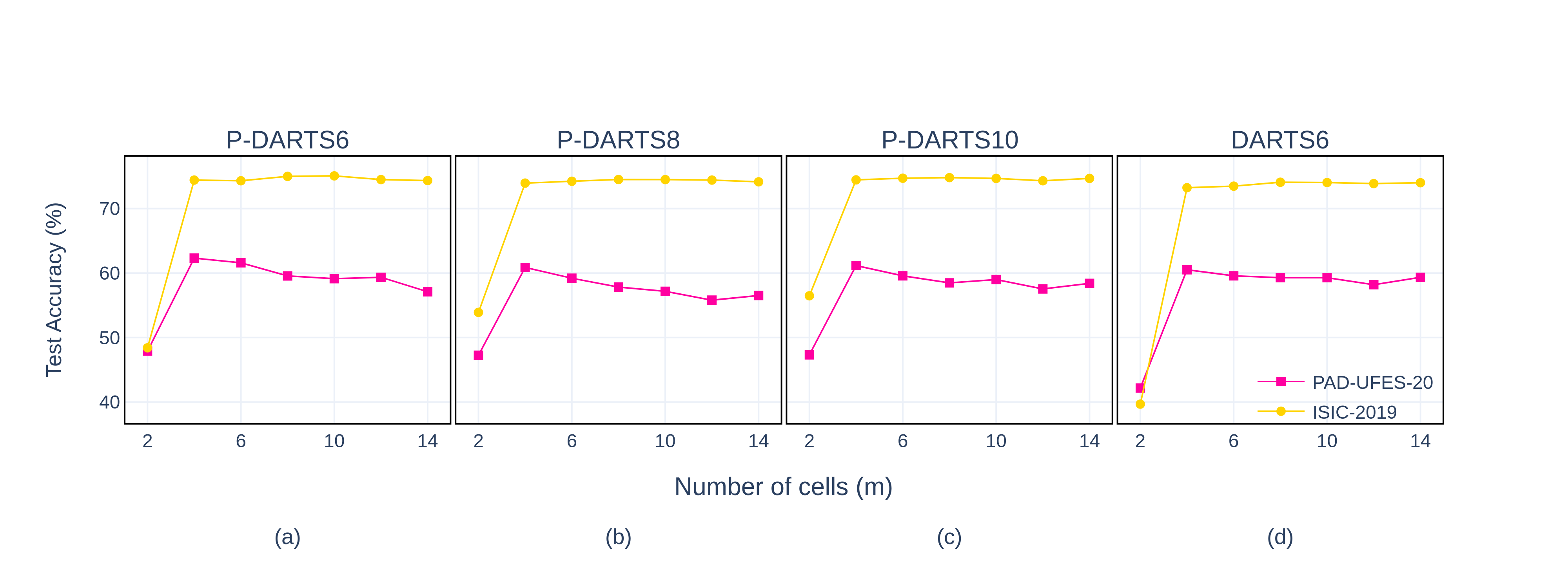
P-DARTS searches at depths 6, 8, and 10. The discovered cells are evaluated in networks containing 2 through 14 cells.
Evaluation settings
The experiments cover six-class and malignant-versus-benign diagnosis at 32×32 and 224×224 resolutions.
Validation
Performance is examined using accuracy, weighted F1, sensitivity, specificity, AUC, repeated architectures, and statistical comparisons.
Key findings
- Transferred P-DARTS architectures remained competitive across PAD-UFES-20 and DermaMNIST despite changes in acquisition conditions and dataset scale.
- At 224×224 resolution, the best reported mean accuracies were 69.06% on PAD-UFES-20 and 79.48% on DermaMNIST.
- The best reported individual PAD-UFES-20 result reached 63.70% for six-class diagnosis and 97.71% for malignant-versus-benign classification.
- Evaluation-network depth was more influential than the absolute gap between search depth and evaluation depth.
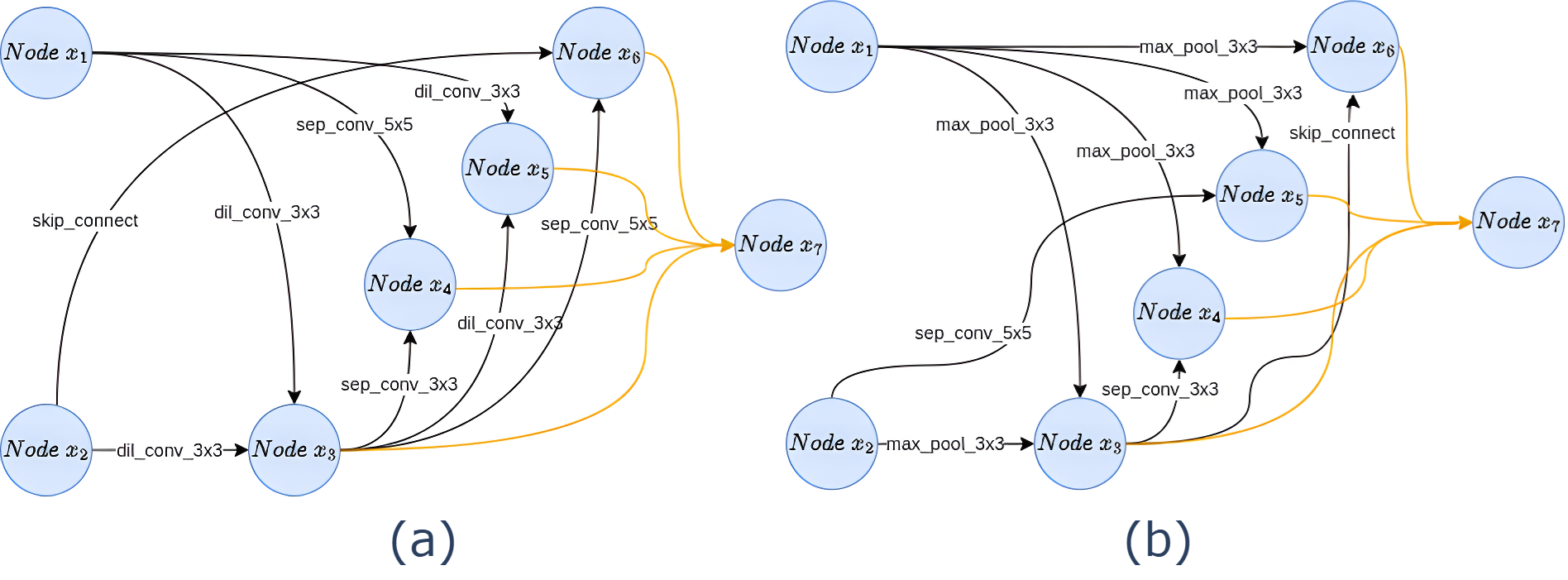
- Pooling operations in the discovered reduction cells were associated with stronger transfer behavior.
Architecture and transfer behavior
Research contribution
The project provides a controlled study of transfer at the architecture level. It separates reusable network structure from pretrained weights and examines how source-data properties, search depth, evaluation depth, cell operations, and image resolution shape transfer performance. This offers evidence that architecture search can produce reusable structural knowledge for data-limited medical-imaging tasks.
Responsible interpretation
This is a retrospective research study, not a clinical diagnostic system. Historical PAD-UFES-20 experiments used image-level splits with possible patient overlap, so future patient-grouped validation must be reported separately. The repository preserves publication-reported results and reproducibility records but does not claim that the maintained package has regenerated the entire manuscript experiment grid.
Citation
Vo, A., He, L., Eskorouchi, A., and Wang, H. (2026). Understanding knowledge transferability in differentiable architecture search for skin lesion diagnosis.IISE Transactions on Healthcare Systems Engineering, 16(1), 71-90.