Smart Agriculture · Internet of Things · Machine Learning · Decision Support
PlantLife365: A Multimodal Sensing and Decision-Support Platform for Plant Health Management
Connecting environmental sensing, authenticated data services, analytics, and an operator-facing monitoring dashboard
Research objective
Plant-health decisions depend on environmental conditions that change continuously, but conventional observation often relies on disconnected measurements and manual inspection. Important changes in moisture, temperature, humidity, light, or gas conditions may therefore be difficult to identify early or evaluate in their temporal context.
PlantLife365 was developed to validate an AI-powered multimodal sensing and data-collection platform for plant health management. The project connects physical sensing with secure software infrastructure so that environmental measurements can be collected, organized, visualized, analyzed, and converted into information that supports timely monitoring decisions.
Multimodal sensing hardware
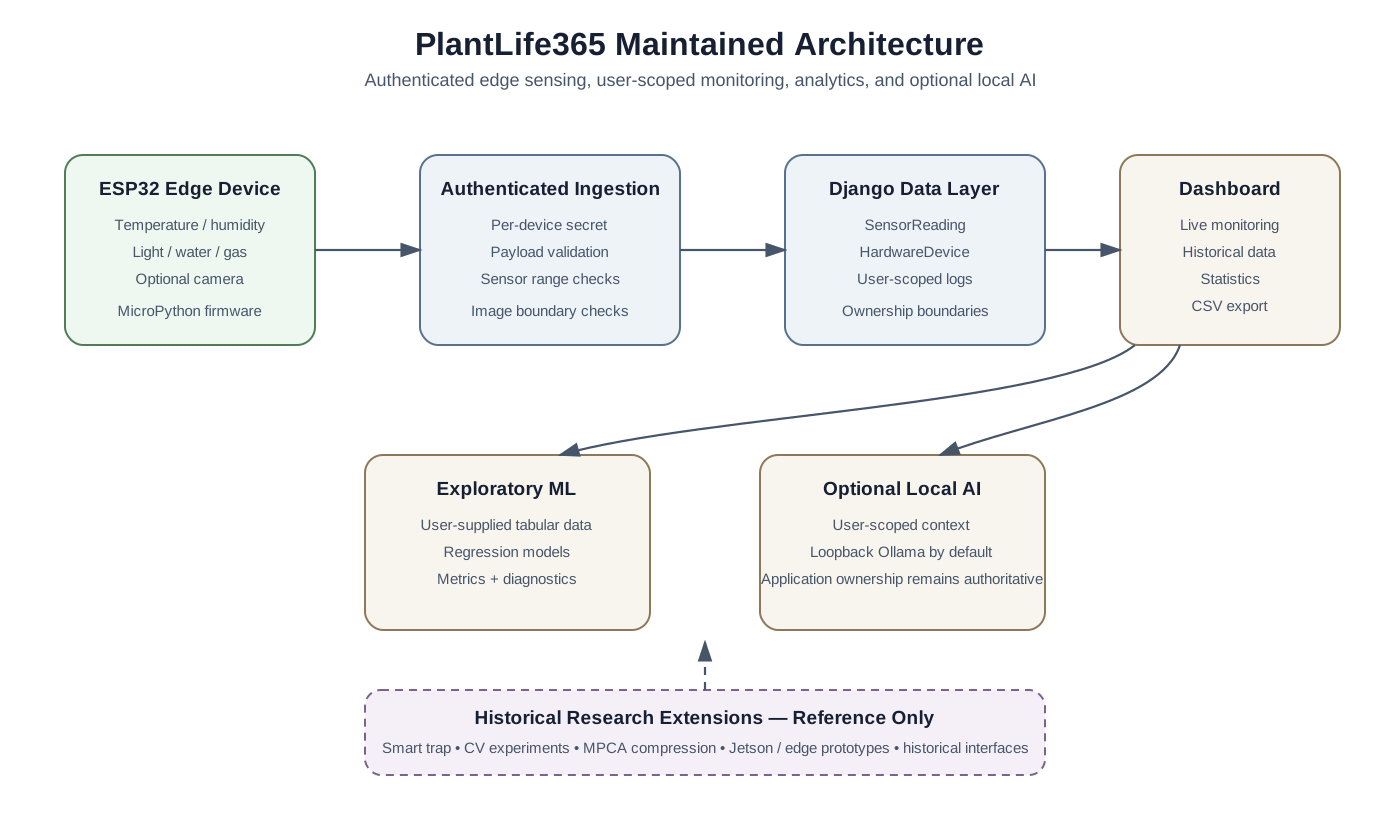
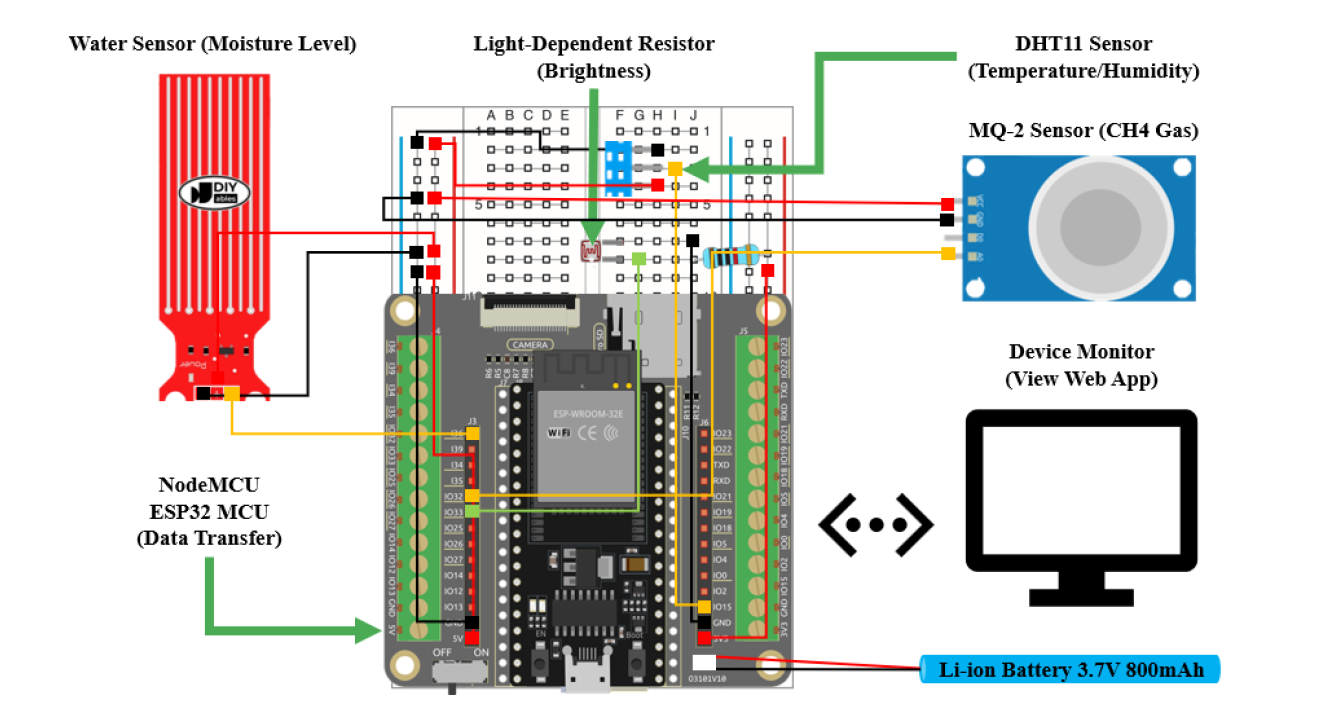
The edge node is built around an ESP32 microcontroller and acquires temperature, humidity, soil-moisture, ambient-light, and gas measurements, with support for optional image capture. The integrated sensor package provides complementary information about the plant and its surrounding environment rather than relying on a single measurement modality.
MicroPython firmware manages sensor acquisition and transfers telemetry to the web platform. Each registered hardware device uses a device secret, and incoming payloads are checked for required fields, numeric validity, finite values, and application-level ranges before they are stored.
Authenticated monitoring and data services
A Django application provides the persistence, data-access, and monitoring layers. Measurements remain associated with the authenticated user's registered devices, allowing current readings, historical records, rolling and daily statistics, alerts, system logs, and exported data to be managed within a user-scoped workflow.
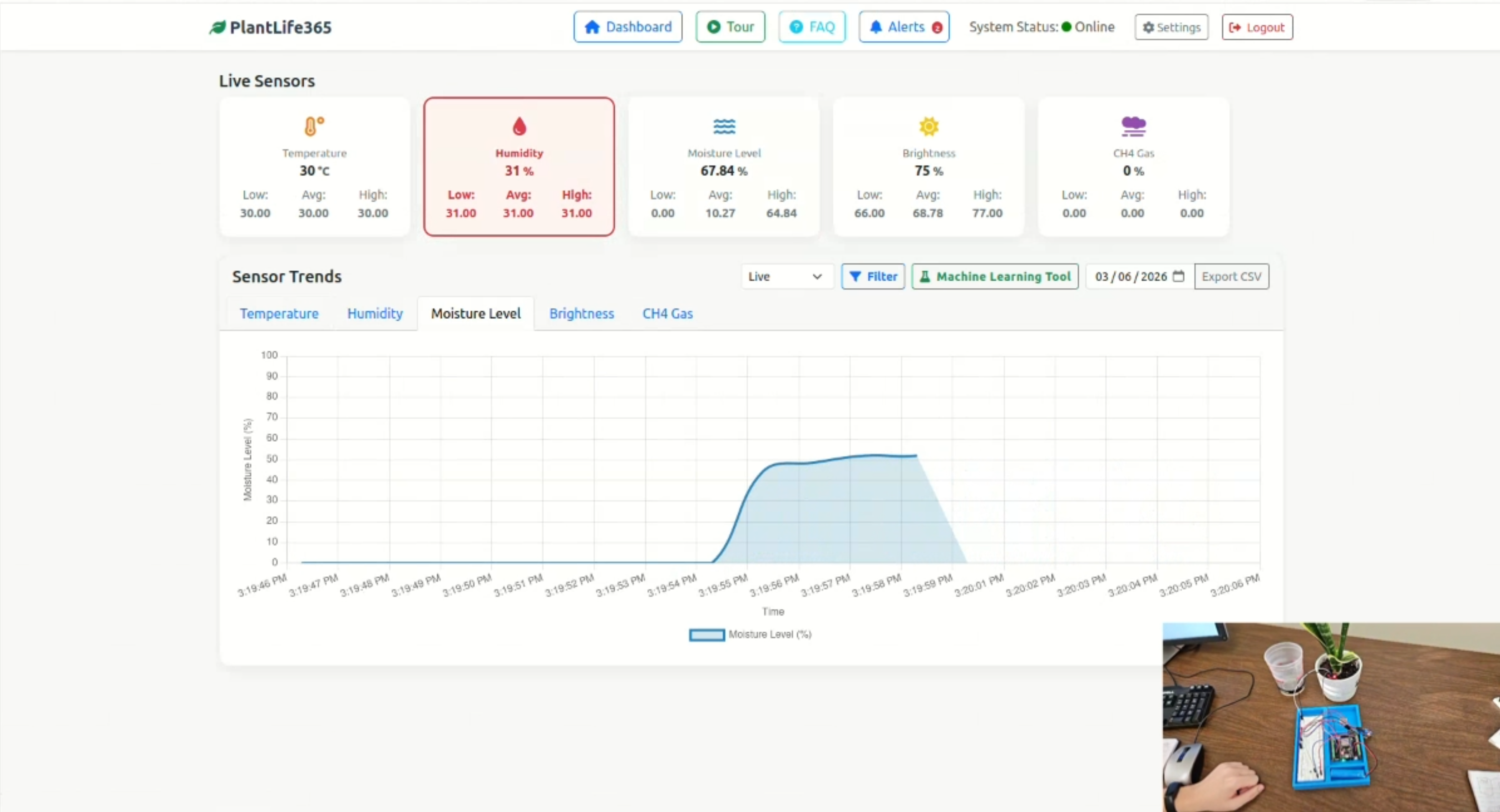
The dashboard presents live sensor conditions and temporal trends in a browser-based interface. Users can review alert states, filter historical records, examine changes across sensors, and export their data for further analysis.
Exploratory machine-learning analytics
PlantLife365 includes a controlled tabular regression workflow for research exploration. Available methods include linear regression, random forest regression, gradient boosting regression, support vector regression, and K-nearest neighbors regression. The workflow reports MAE, RMSE, R-squared, actual-versus-predicted diagnostics, and model-specific descriptive feature scores where available.
These tools are intended for exploratory analysis of user-provided sensor data. They are not presented as a validated agronomic forecasting or recommendation model. This distinction keeps the platform useful for research while clearly separating analytical experimentation from verified agricultural guidance.
Optional local AI assistance
The maintained application also supports an optional local Ollama-compatible assistant. When enabled, the assistant receives a compact context assembled from the authenticated user's current monitoring information and recent user-owned logs.
The local design supports privacy-conscious experimentation and keeps monitoring context scoped to the authenticated user. Generated responses remain advisory interface output and are not treated as verified agronomic recommendations.
Selected capabilities
- ESP32-based multimodal environmental sensing and optional imaging
- Per-device authenticated telemetry ingestion
- User-scoped current and historical monitoring data
- Rolling statistics, daily summaries, alerts, and system logs
- Date-based queries and CSV data export
- Controlled exploratory regression analytics
- Optional local AI assistant grounded in user-owned monitoring context
- Automated tests and continuous integration for the maintained software
Recognition
The recognition reflects the project's integration of physical sensing, data engineering, machine learning, full-stack software development, and user-facing decision support into a functioning system.
Reproducible research software
The public repository preserves the ESP32 firmware, Django application, data services, analytics workflow, tests, documentation, dependency records, validation scripts, and system architecture. Historical experimental branches are documented separately from the maintained functionality so that the current software baseline remains clear and reproducible.
Project support
Mississippi Institutions of Higher Learning