Machine Learning · Optimization · Intelligent Manufacturing
Distributionally Constrained Visual Quality Measurement Using Unbalanced Optimal Transport
Wood-chip size estimation for manufacturing process monitoring
Under review at Decision Support Systems
Research problem
Conventional object detectors are optimized to identify individual objects accurately. In manufacturing quality monitoring, however, the downstream decision may depend on recovering the physical distribution of the complete object population. Missed small, overlapping, or partially occluded chips can therefore bias the estimated size distribution even when conventional detection metrics appear strong.
Method
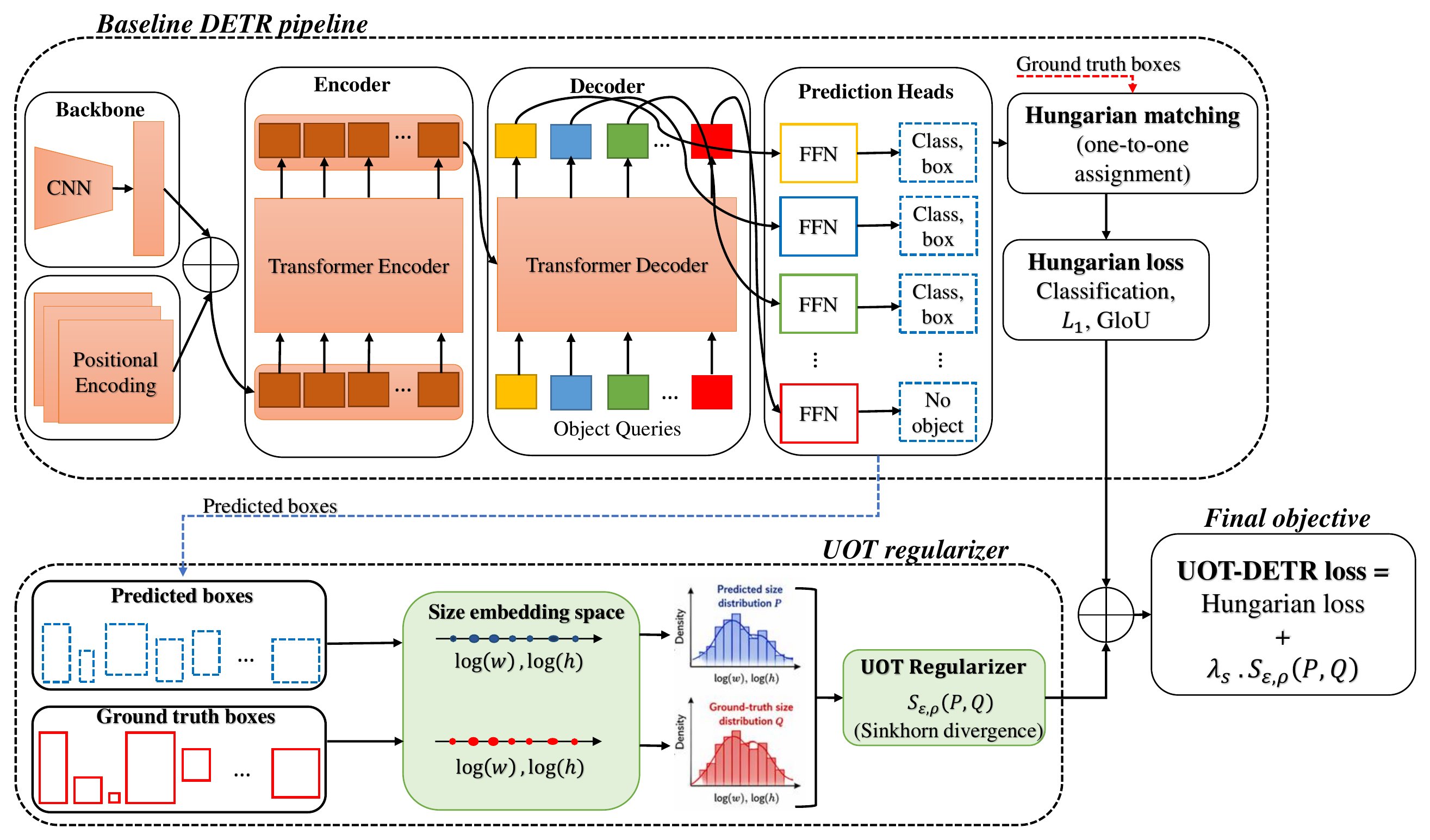
UOT-DETR integrates an unbalanced optimal transport regularizer into DETR training. The regularizer compares predicted and reference measures in normalized log-size space and accommodates missing or additional predicted mass. It complements DETR's instance-level Hungarian supervision with a population-level distribution objective.
The UOT component is used only during training. Prediction follows the standard DETR inference path, so the method introduces no additional inference-time overhead.
Selected results
- mAR50: 95
- Overall mAR50-95: 72
- Small-object mAR50-95: 42
- Small-object mAR50 improvement over DETR: 24.7 percentage points
- Small-object mAP50 improvement over DETR: 15.4 percentage points
- Reported KL divergence: 0.041 to 0.048
The largest improvements occurred for small objects in medium- and high-clutter scenes, where faithful recovery is most difficult and most relevant to population-level quality measurement.
Project support
USDA-NIFA