Edge AI · Computer Vision · Intelligent Manufacturing
Wood-Chip Monitor: An Edge-AI System for Real-Time Wood-Chip Quality Evaluation
Transforming streaming RGB imagery into operational quality intelligence
Finalists, 2026 IISE DAIS Student Mobile/Web App Competition
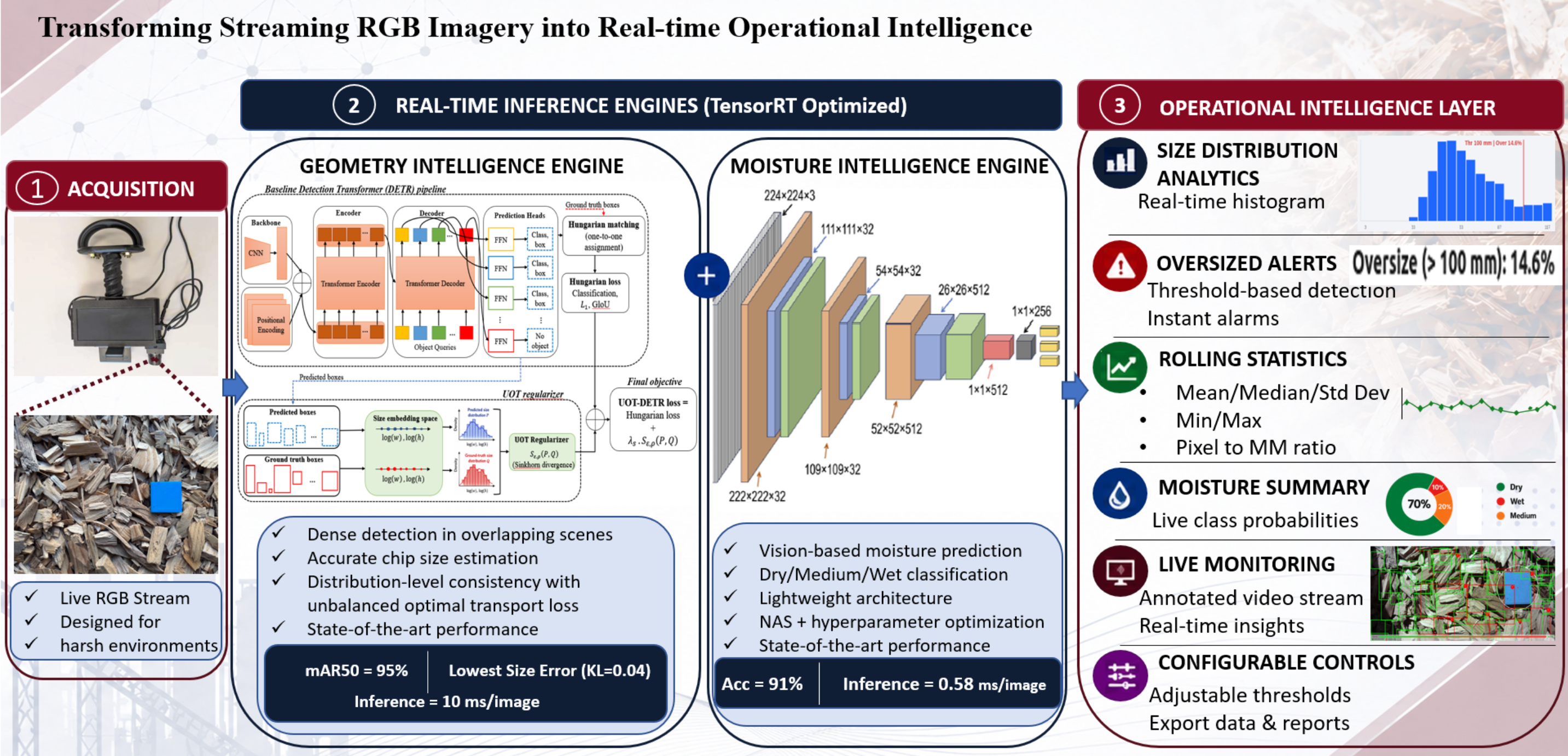
From periodic sampling to operational intelligence
Wood-chip quality affects process stability, product consistency, and energy efficiency in pulp, paper, and bioenergy manufacturing. Conventional assessment commonly depends on periodic manual sampling and offline measurements, limiting how quickly operators can respond to changes in chip geometry or moisture condition.
Wood-Chip Monitor was developed as a portable edge-AI platform that moves visual quality assessment closer to the production environment. It transforms a live RGB stream into physical measurements, population-level statistics, quality alerts, and operator-facing information without requiring cloud inference for the primary inspection workflow.
End-to-end system architecture
The platform connects three layers. The acquisition layer captures streaming RGB imagery using the portable camera system. The inference layer executes TensorRT-optimized geometry and moisture models on NVIDIA Jetson hardware. The operational layer converts the resulting measurements into rolling statistics, size distributions, oversize alarms, moisture summaries, live annotations, and configurable quality controls.
This design moves beyond a model-only demonstration by connecting computer vision with calibration, physical measurement, data persistence, backend services, device monitoring, and a browser-based operator interface.
Geometry and moisture intelligence
The geometry engine uses a DETR-based detector to localize individual chips in dense and overlapping scenes. Scene calibration converts image-space detections into physical dimensions, which are aggregated into rolling size-distribution statistics and evaluated against configurable oversize thresholds. The associated UOT-DETR research introduces a distributionally constrained training objective to improve recovery of the observed chip population.
The moisture engine uses MoistNetLite, a lightweight vision model, to classify selected chip regions as dry, medium, or wet. A configurable Top-K strategy limits moisture inference to representative high-confidence detections, bounding the computational cost in dense scenes while preserving a live frame-level moisture summary.
Selected outcomes
- Geometry-engine mAR50: 95%
- Reported size-distribution error: KL = 0.04
- Moisture-classification accuracy: 91%
- TensorRT-optimized execution on an NVIDIA Jetson edge device
- Local browser dashboard for live monitoring and quality control
Together, these components demonstrate the complete translation of research methods into a portable intelligent system for real-time manufacturing decision support.
System demonstration
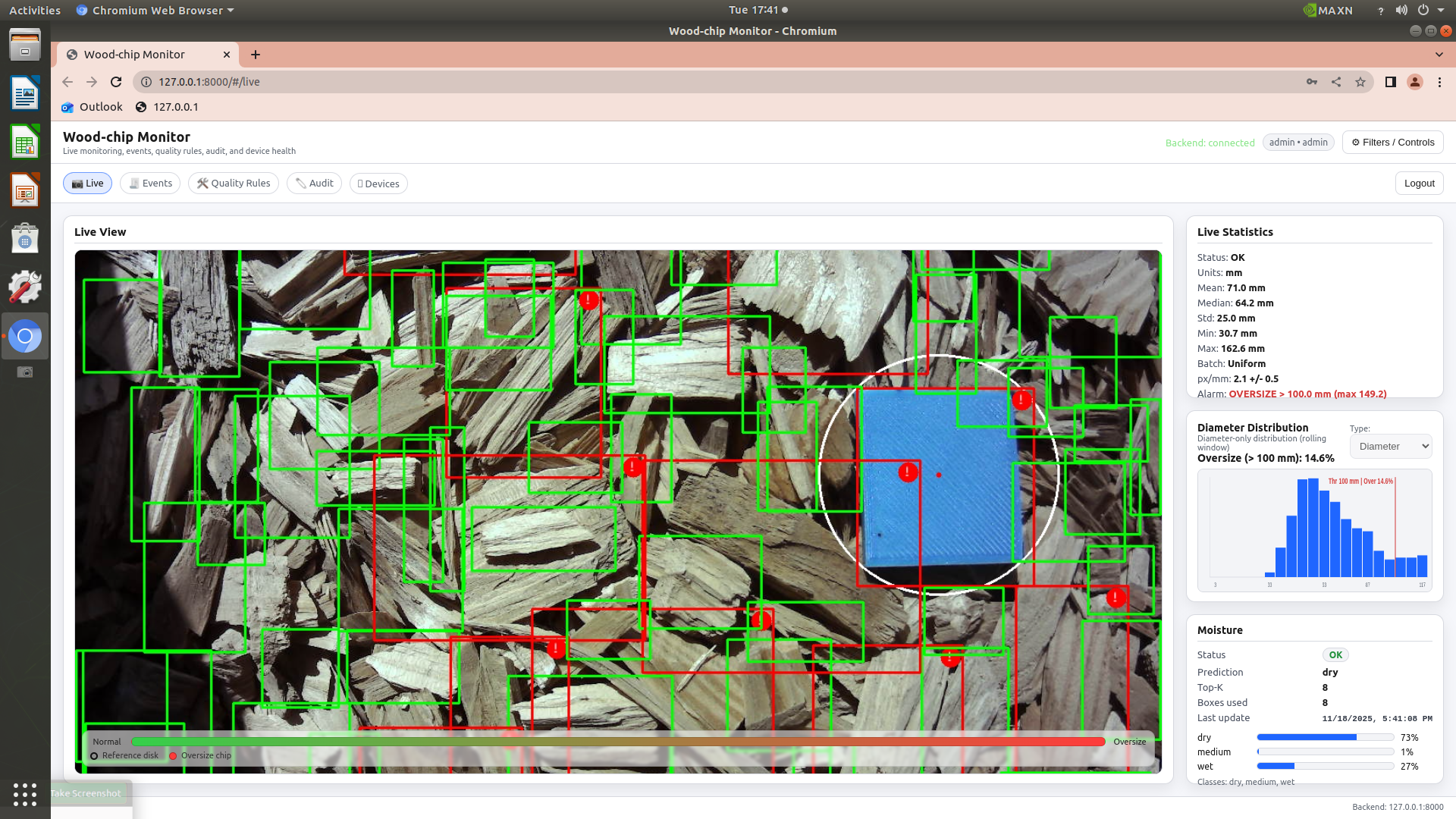
The demonstration shows the deployed monitoring workflow, including live camera inference, detected and measured chips, rolling quality statistics, oversize alerts, and moisture information.
Deployed interface and portable prototype
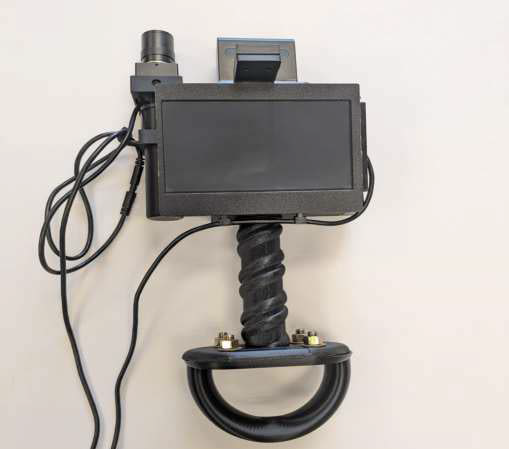
The dashboard provides live inspection imagery, physical size statistics, distribution summaries, oversize status, moisture estimates, configurable rules, event history, audit information, and device status. The physical prototype integrates the camera, Jetson computer, local display, and custom enclosure into a portable platform.
Connected research ecosystem
Wood-Chip Monitor is the deployment layer of a broader research program. UOT-DETR provides the distributionally constrained geometry engine, the WoodChip-Detection dataset supports dense detection and measurement research, and MoistNetLite supplies the lightweight moisture component. The public repository preserves the application, model definitions, validation records, deployment documentation, and hardware CAD files.
Project support
USDA-NIFA and the Sun Grant Initiative (SGI). Physical prototype development was associated with the AI2F Summer 2025 program.